
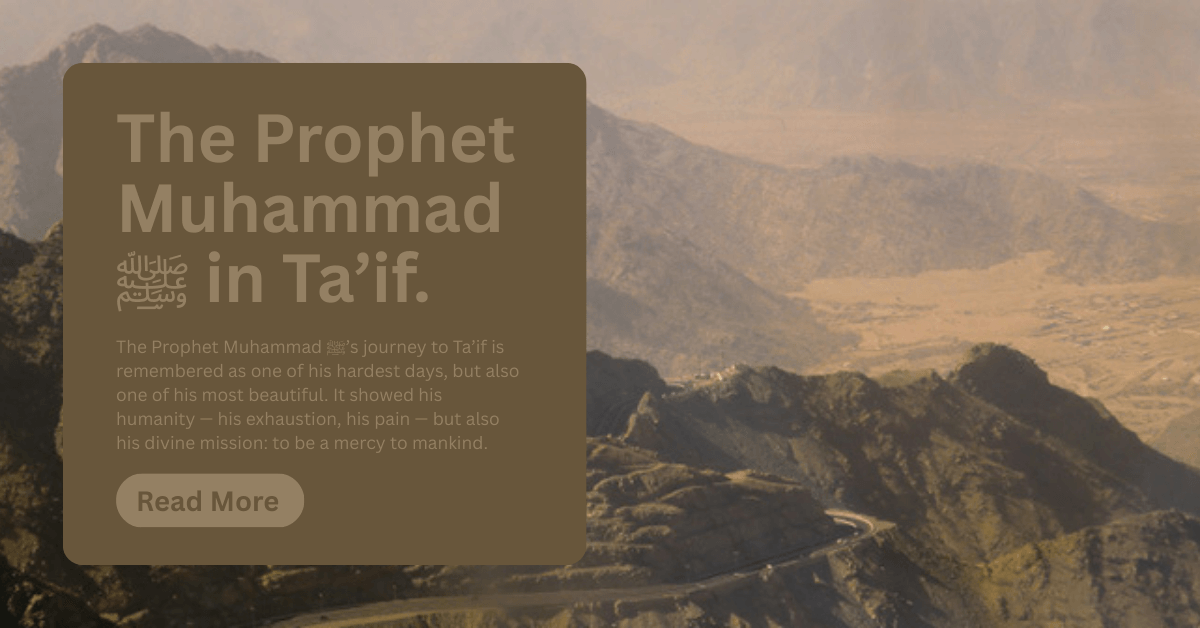
In the tenth year of Prophethood, the Messenger of Allah ﷺ faced one of the most difficult and heartbreaking experiences of his blessed life. This event is known as the Journey to Ta’if, and it became a timeless lesson in patience, mercy, and reliance upon Allah.
The Context: Hardship in Makkah
By this time, the Prophet ﷺ had been calling people to Islam for a full decade. In those years, he faced rejection after rejection in Makkah. The Quraysh mocked him, insulted him, spread lies about him, and tortured his followers. He bore it all with extraordinary patience, never once abandoning his mission.
But the year in which he journeyed to Ta’if is remembered as the “Year of Sorrow” (ʿĀm al-Ḥuzn). Why? Because in the span of a few months, the Prophet ﷺ lost two of his greatest supporters:
-
Abu Talib, his beloved uncle who had protected him from the hostility of Quraysh.
-
Khadijah (RA), his wife, his partner, and the source of immense comfort and strength.
With their deaths, the Prophet ﷺ’s protection in Makkah weakened. The Quraysh became even more emboldened in their hostility. At this time, the Prophet ﷺ turned to a nearby city — Ta’if, about 60 miles away — hoping its leaders might support his mission.
The Journey to Ta’if
The Prophet ﷺ did not go alone. He was accompanied by his loyal servant and adopted son, Zayd ibn Harithah (RA). Together, they walked the long, difficult road to Ta’if. Imagine the scene: two weary travelers, with dust on their clothes, carrying no wealth, no armies, no worldly power. Just a message of truth, hope, and salvation.
The Prophet ﷺ’s heart was full of sincerity. He did not seek wealth or power — he only sought a safe space to spread the message of Islam. Perhaps the people of Ta’if would open their hearts where the Quraysh had closed theirs.
The Leaders of Ta’if
When the Prophet ﷺ arrived, he met with the three chiefs of the city — ʿAbd Yalayl, Mas’ood, and Habib, the sons of ʿAmr. He presented Islam to them, inviting them to believe in Allah alone and support his mission.
But instead of responding with dignity, they mocked him cruelly. One said:
“Could Allah not find anyone better than you to send as a Prophet?”
Another said:
“If you are truly a Prophet, then I will not even speak with you, for you are too great for me. And if you are lying, then you are beneath me.”
And the third said:
“By Allah, I will never speak a word to you. If you are a Prophet, you are too dangerous to reject. And if you are lying, you do not deserve my attention.”
Their words were dripping with arrogance and disdain.
But their rejection did not end with words. They incited the street children and troublemakers of Ta’if to insult the Prophet ﷺ. They hurled stones at him, chasing him out of the city. His body was struck again and again until his blessed shoes filled with blood. Zayd (RA) tried to shield him, suffering wounds himself.
Can you imagine? The greatest of creation ﷺ, the Messenger of Allah, driven out by mobs, humiliated and hurt. Yet even in this moment, he bore everything with silent dignity.
The Garden Outside Ta’if
Wounded and exhausted, the Prophet ﷺ finally found shelter in an orchard outside the city. The orchard belonged to two wealthy Qurayshi brothers, ʿUtbah and Shaybah ibn Rabiʿah. Though they were enemies of Islam, even they felt pity seeing the Prophet ﷺ in such a state. They sent their servant, ʿAddas, a Christian man, to offer him some grapes.
When the Prophet ﷺ took the grapes, he said:
“In the name of Allah (Bismillah).”
ʿAddas was surprised, for no Arab commonly used this phrase. He asked:
“What are these words?”
The Prophet ﷺ replied:
“This is the name of Allah, my Lord and your Lord.”
A conversation followed, in which the Prophet ﷺ discovered that ʿAddas was from Nineveh, the city of Prophet Yunus (Jonah, peace be upon him). The Prophet ﷺ said:
“That is the city of my brother Yunus ibn Matta. He was a Prophet, and I am a Prophet.”
ʿAddas was overwhelmed. He kissed the Prophet’s hands and feet, recognizing the truth in his words. For a moment, in that lonely garden, Allah granted His Messenger ﷺ a sign of comfort — a reminder that hearts could still open to the truth.
The Angel of the Mountains
But the greatest moment of this story came when the Prophet ﷺ, bloodied and broken, lifted his hands in prayer. His words were full of humility:
“O Allah, to You alone I complain of my weakness, my lack of resources, and my humiliation before the people. O Most Merciful of those who show mercy… If You are not angry with me, then I do not care what I face. But Your favor is more expansive for me. I seek refuge in the light of Your Face which dispels all darkness and sets right the affairs of this world and the next…”
It was at this moment that Allah sent the Angel Jibreel with the Angel of the Mountains. Jibreel said:
“O Muhammad, Allah has heard the words of your people and their rejection of you. If you wish, I will command the Angel of the Mountains to crush them between the two mountains surrounding Ta’if.”
Now think: anyone else, after being insulted, beaten, and humiliated, would have seized the chance for revenge. But the Messenger of Allah ﷺ was sent as a mercy to the worlds.
Instead, he raised his blessed voice and said:
“No. I hope that Allah will bring forth from their descendants people who will worship Him alone, without associating partners with Him.”
This response was not only forgiveness; it was vision. The Prophet ﷺ could see beyond the present rejection, beyond the pain, into a future where faith would grow even from this hostile soil.
The Fruit of Patience
Years later, when Islam spread across Arabia, the people of Ta’if indeed accepted Islam. The very descendants of those who mocked and stoned the Prophet ﷺ became Muslims, fulfilling his hopeful prayer.
Lessons from the Waqia of Ta’if
This waqia is more than history. It is a school of faith that teaches us eternal lessons:
-
True Leadership is Patience: The Prophet ﷺ showed us that a leader does not abandon his mission when faced with rejection. He endures, trusts Allah, and continues with dignity.
-
Mercy Above Revenge: Where others would seek destruction, the Prophet ﷺ sought guidance and mercy. His vision extended beyond personal pain to the possibility of future good.
-
Turning to Allah in Weakness: His duʿāʾ in the orchard is a model for us. In moments of humiliation, we do not collapse into despair — we turn to Allah with honesty, humility, and trust.
-
Hope Beyond the Present: Even when everything seems dark, Allah can bring light. The Prophet ﷺ planted seeds in Ta’if that blossomed years later.
A Legacy of Mercy
The Prophet Muhammad ﷺ’s journey to Ta’if is remembered as one of his hardest days, but also one of his most beautiful. It showed his humanity: his exhaustion, his pain: but also his divine mission: to be a mercy to mankind.
Whenever we face hardship, rejection, or insult, this waqia reminds us: if the Messenger of Allah ﷺ, the best of creation, could endure so much yet still respond with forgiveness, then we too must strive for patience, mercy, and hope.